Nerja
Public Transport
The popular town of Nerja lays east of Malaga. It’s a short drive with a vehicle. As we are generally without a car, we rely heavily on the regions public transportation. Sadly Malaga’s C1/C2 train lines do not extend east of Malaga. Meaning one must rely on their “long haul” bus system. Luckily the main bus station is directly across from the train station, making transfers between the two a breeze. And if you have an extra minute or two, there’s a bakery called Granier that sells divine pastries next to the bus entrance. I particularly enjoy the swirly thing with pistachio cream. Plus their restroom is much nicer than the bus stations bathroom. Important things to know.

Use Alsa.com to book your ticket in advance. I think it’s around €6 per person one way. Just make sure to enter the correct destination. If you simply want to visit Nerja, then select the town, Nerja. However, if you want to journey to the caves, be aware that this is a completely different bus. Also note these two busses tend to park next to each in their designated slots and there will likely be mass confusion regarding which bus to stand in line for. There are signs and the slots are numbered but for some reason, the confusion remains. And not just with foreign tourists. Also note, it’s completely normal to wonder if the bus will even show up. They often arrive a few minutes prior to their departure time. And in the meantime a few different buses may pull in to drop people off. Which was vastly confusing the first time around.

If you visit the caves and want to head back to Nerja (town), you can take a bus or it’s a relatively short taxi/UBER/Bolt ride away. We chose to walk to Nerja as there are a few things on the way that we desired to stop by. I believe the walk takes about one hour at a leisurely stroll. As long as you don’t take as many diversions as we did. From the cave to town is downhill and mostly in the sun.

Regardless of where you’re leaving from, either the caves or town, it may behoove you to have a pre booked return ticket. These busses are frequently packed and it’s quite possible you wont get on. Our first trip out we walked over to the tiny ticket office in Nerja, which is directly by the bus drop off/pick up site, and were informed the next opening for two persons was in about 3 hours. Ouch. Lesson learned. Luckily for us, Nerja is relatively easy to kill time in.
Nerja Caves
The Nerja caves are quite possibly the main attraction in the Nerja region. This cave system spans just over 3 miles and contains spectacular geological formations. The cave is divided into two sections. Section one is open to the public. Entrance to the caves is via concrete staircase descending into the cave. From there you’ll follow a paved trail.

The first cavern you enter in the cave acts as a natural amphitheater. Apparently, they hold fairly regular concerts in here. As you wander the trail, take in its splendor. Massive stalactites and stalagmites are seen throughout the show galleries of the cave. The cave boasts the world’s largest column, coming in at 43 feet by 23 feet at the base and stands 105 feet tall. It’s wondrous to walk around this column. Gazing at it, one can’t help but feel miniscule.

Section two of the Nerja cave is not open to visitors. Somewhere within the caves are supposed Neanderthal cave paintings. As the area is considered delicate, no visitation is allowed. To view them, we were instructed to view the caves VR experience. It’s included in your admission ticket.

Once done with the cave, there’s a museum, botanical garden, walking paths, children’s playground and even a cafe to enjoy if you so choose. Access into the Parque Natural de las Sierras de Tejeda, Almijara y Alhama is directly next to the cueva entrance, making this a great spot for hiking as well. We enjoyed hiking to Frigiliana from the cave area and back a day later as described in NERJA CUEVA TO FRIGILIANA VIA GRAN SENDA DE MALAGA and FRIGILIANA TO NERJA CUEVA VIA SENDERO DE TAJO BAENA.

Aqueducts
The Eagle Aqueduct, or Acueducto del Águila, is well worth a stop if you have time. Built around 1880, this aqueduct’s purpose was to deliver water to the nearby San Joaquín de Maro sugar factory. While the factory has long since closed, the aqueduct continues to bring a steady water supply for local field irrigation.

The structure itself is composed of four stories of horseshoe arches. There are 38 total arches and a pavilion of sorts in the center. It’s rather impressive.

We chose to walk here from the caves. There’s a trail directly off the main road leading to/from the caves. It’s not signed. The trail steers you toward the aqueduct, though a bit further up the ravine. At one point you drop into the ravine to cross sides where the trail then turns south toward the aqueduct. Once at the aqueduct you can see water actively passing through. We found it amusing to poke around a bit and look to our hearts content.

One can get a bottom-up view by heading to the base. To get here turn off the N340 and head down a dirt road toward the Puente del Águila, which is an old single arch bridge. I’ve no idea what the road name is. Continue down the road to the ravine floor and walk toward the aqueduct.

If you don’t have the time or inclination to visit these walk in sites, there is a pull out along the N340 where you can stop for a quick photo.
Walking into Nerja, we passed the Table Aqueduct, or Acueducto Tablazo o del Agua de Hierro. This aqueduct was also constructed in the late 19th century and is reportedly still in use today for irrigation purposes. Its arches are constructed of plastered masonry and brick. As it’s basically on the outskirts of town, there are vehicles parked alongside the aqueduct making for less than ideal photo opportunities. Regardless, it’s still a beautiful structure.

Abandoned Factories
Speaking of sugarcane factories, the Fábrica de Maro, lays a bit past the Eagle aqueduct. This abandoned factory was entertaining to get to as we wound up walking along a random dirt road in the wrong direction before changing course.

The factory is situated in a large, flat field. At the time we visited there were no fences or signs saying to keep out. So we walked on in. There are a series of dilapidated structures to walk through. Quite a few of the walls are covered in graffiti. If you can look beyond the modern scrawl, it’s a fascinating place to wander.

I adore old buildings and would have happily stayed longer. However, there was a tent pitched in one of the rooms. Which made Doug convinced we were intruding on a vagrant squatter. Which made him want to get the heck out. I was not of the same general impression. Whomever was camping had quite a nice setup. Good quality tent and visible backpacking gear for cooking. Regardless, we left. From the center of the factory front (on the N340 side) there’s a path to a country road between farms. Much easier access to the N340 and we got to walk past a whole lot of avocado trees.

Nerja
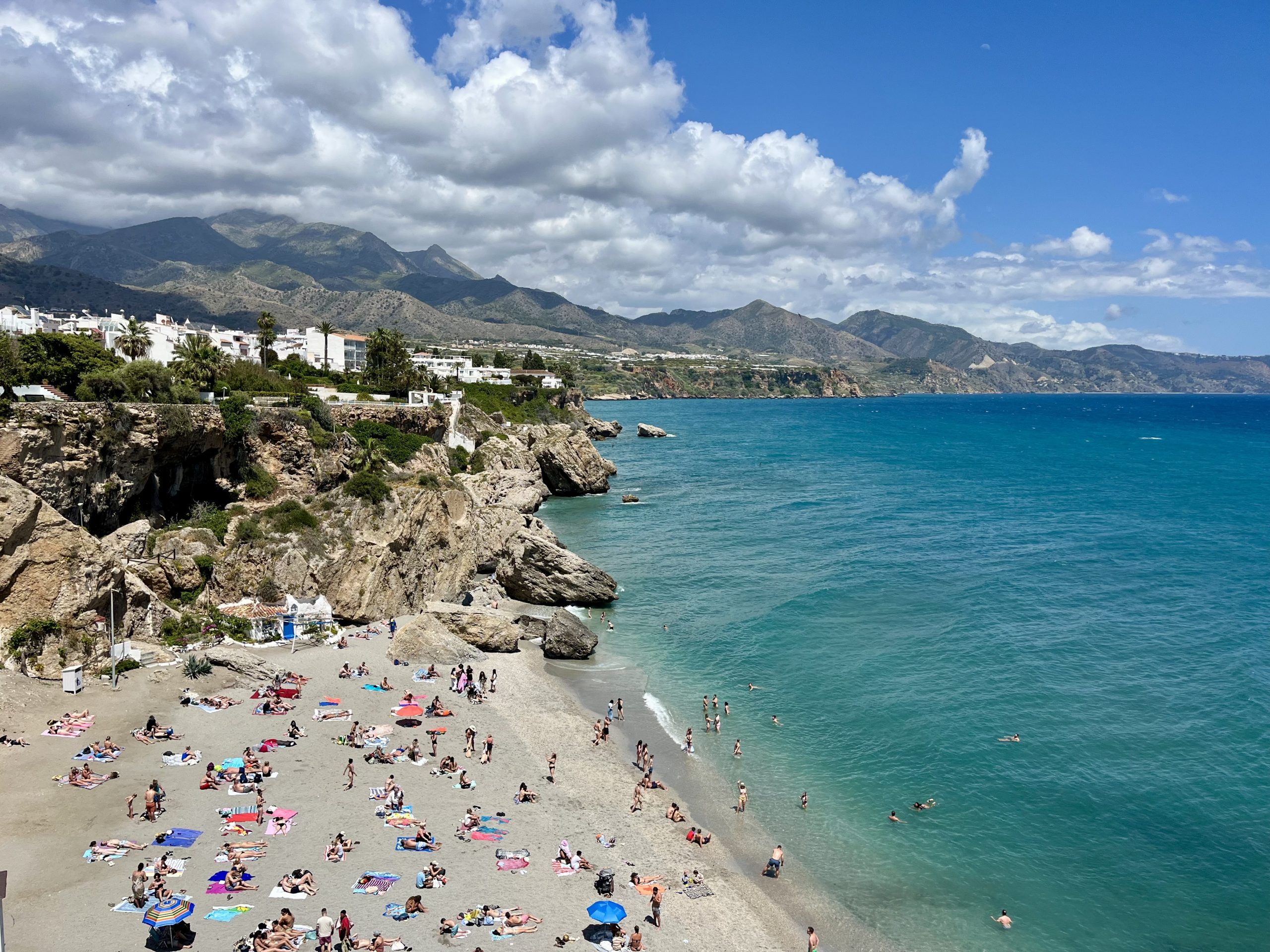
The ever popular Balcón de Europa seems to be where you’ll find the majority of tourists in Nerja. This cliffside viewpoint yields stunning panoramic sea views as the promenade progresses from the town center toward the sea. Apparently the balcony used to be the location of a 9th century fortress. Today the balcony is iconic to Nerja. Toward the town center, you’ll find a plethora of shops to browse through and restaurants to tempt you. There are a few gelatto shops, two are directly next to one another. When we were there, one had a ridiculously long line, which we joined for no other reason than it had a long line. Can’t say the sorbet I chose was any better than any other I had previously consumed. Walking around this section of town you’ll find traditional white washed streets and walkways that’ll lead into the old town.

Heading down the promenade there’s a water fountain with potable water. There are benches lining the promenade, a statue and some old canons. The promenade lays on a cliffside that separates two beaches. To the east lays Playa de la Calahonda, which can be accessed off the balcony through an arched gate. Stairs lead down to the coved beach. On the west side of the balcony lays El Salón beach. Both are quite picturesque, though the former seems more popular and crowded.

As Nerja is on the Alboran Sea, there are plenty of beaches to choose from. Where you settle in may depend on location. Beside the beaches on either side of the balcony there’s Playa El Chorrillo and Carabeo Beach, which are far less crowded with day tourists. Furthest from the balcony is Playa Burriana which has hammocks for rent, is lined with cafes and offers kayak rentals. All the beaches are gorgeous and come with varying crowds.

Killing Time
When we found we had time to kill before our bus arrived, we looked at each other with “now what” expressions. Walked up from the ALSA bus station, grabbed a snack at a small convenient store. From there we wandered.

We meandered into a nearby cemetery. Spanish cemeteries are so peaceful and serene. Admired the burial sites. Found a very aloof black cat who seemed to be the guardian of the cemetery.

After strolling through a few streets, we sought out the semi ruins of Maquinilla de RIFOL. Originally this place was a flour mill. Later on it was converted into a sugar cane honey factory and was in operation until about 1940. Today it’s fenced off and in sad shape. We viewed it from the street above and could peek through the fence to glimpse inside. If you like old buildings it’s worth a visit. Of note, there was a section where locals seem to toss their old beer cans. Skol seemed to be the preferred brand and well outnumbered the other cans. We tried that beer a while later, wasn’t half bad.

It’s A Wrap
We have enjoyed our trips out to Nerja. It’s a busy tourist town but maintains its charm. There are plenty of beaches and scenic points to keep most everyone busy and content, whether it’s soaking up the sun on a beach or exploring the surrounding region.


Leave a Reply